When count data have a known upper bound — the number of successes out of a fixed number of trials — the binomial logistic regression model is appropriate. This guide covers the binomial distribution, the relationship to binary logistic regression, and practical fitting with glm using the cbind response syntax.
Bounded count data
Poisson regression models unbounded counts — in principle, any non-negative integer is possible. But some counting situations have a natural maximum: the number of questions answered correctly out of a fixed test, the number of items approved out of a batch of known size, or the number of putts made out of a fixed number of attempts. In these cases, the binomial distribution is the appropriate likelihood.
The binomial logistic regression model
For observation \(i\), suppose \(y_i\) is the number of successes in \(n_i\) independent trials, where each trial succeeds with probability \(\theta_i\). The model is
The same logit link and linear predictor from binary logistic regression appear here. When \(n_i = 1\) for all observations, the binomial distribution reduces to the Bernoulli distribution and this model becomes ordinary binary logistic regression.
Fitting with glm
The golf_putts.csv dataset records the number of successful putts and attempts at each distance from the hole.
Rows: 19 Columns: 3
── Column specification ────────────────────────────────────────────────────────
Delimiter: ","
dbl (3): distance, attempts, success

ℹ Use `spec()` to retrieve the full column specification for this data.
ℹ Specify the column types or set `show_col_types = FALSE` to quiet this message.
Call:
glm(formula = cbind(success, failure) ~ distance, family = binomial(link = "logit"),
    data = golf_df)

Coefficients:
             Estimate Std. Error z value Pr(>|z|)
(Intercept)  2.231211   0.058463   38.16   <2e-16 ***
distance    -0.255692   0.006691  -38.22   <2e-16 ***
---
Signif. codes:  0 '***' 0.001 '**' 0.01 '*' 0.05 '.' 0.1 ' ' 1

(Dispersion parameter for binomial family taken to be 1)

    Null deviance: 2411.10  on 18  degrees of freedom
Residual deviance:  255.34  on 17  degrees of freedom
AIC: 365.92

Number of Fisher Scoring iterations: 4
Interpreting and predicting
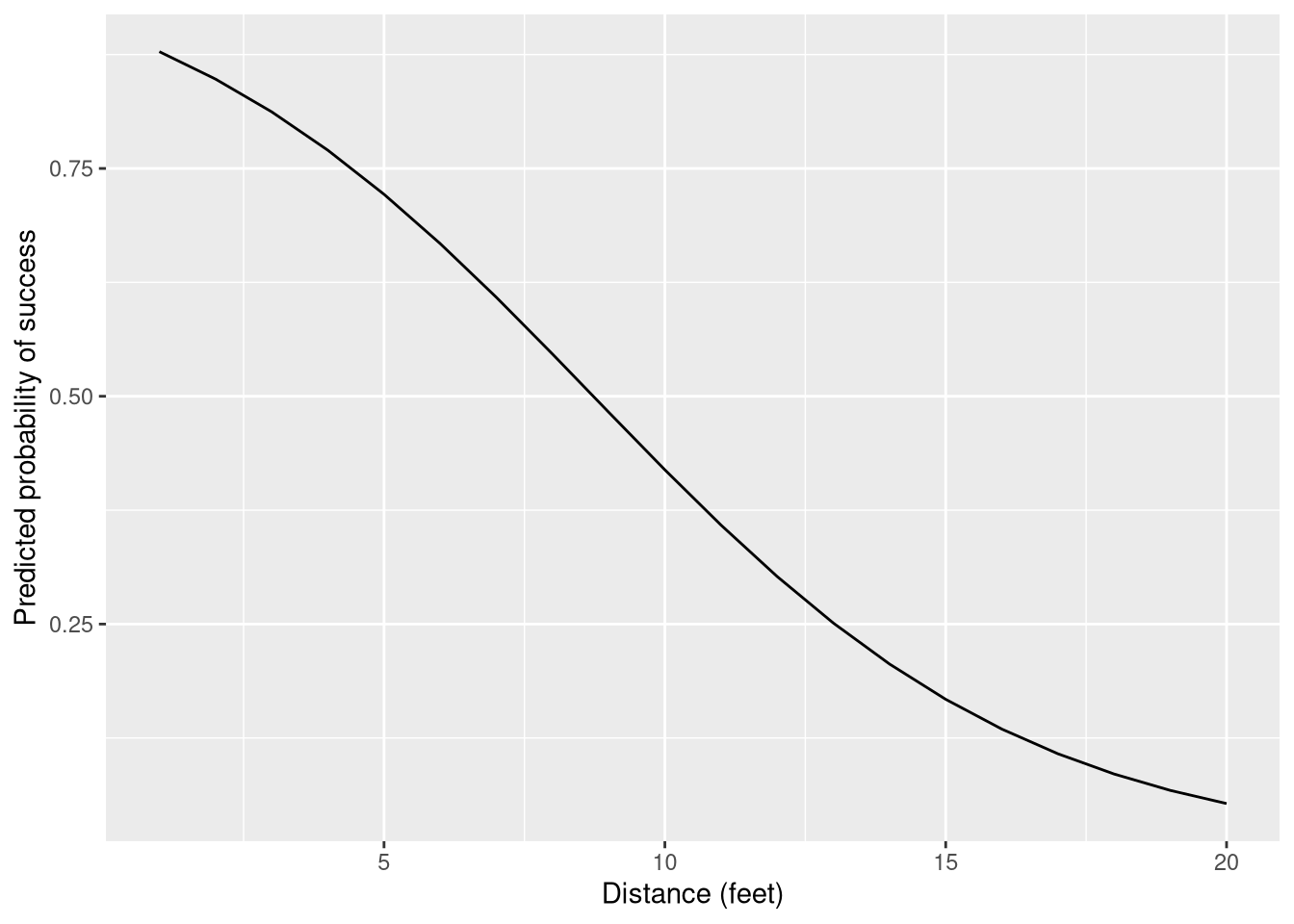
The coefficient for distance is on the log-odds scale. A negative coefficient means that the log odds of success decrease as distance increases, which is what we expect for golf putting.
Predicted probabilities over a range of distances:
golf_new <-tibble(distance =seq(1, 20))add_predictions(golf_new, M_bin, type ="response") |>ggplot(aes(x = distance, y = pred)) +geom_line() +labs(y ="Predicted probability of success",x ="Distance (feet)")
Relationship to binary logistic regression
The binomial logistic regression model reduces exactly to binary logistic regression when every \(n_i = 1\). In that case, cbind(success, failure) has rows of the form (1, 0) or (0, 1), and the model is identical to fitting glm(y ~ x, family = binomial) where y is the binary outcome. The two are the same model; the binomial is simply the more general form.